No genealogy. No manger. No philosophical prologue easing you into the story. When you open the Gospel of Mark, you are thrown straight into the action — and Mark has no intention of slowing down.
This is the shortest of the four Gospels, written in rough, unpolished Greek by a man who was not even an eyewitness to the events he describes. It has no birth narrative, no Sermon on the Mount, no Lord's Prayer. By every measure a modern publisher might value, Mark seems the easiest to overlook. And yet this bare-bones, breakneck account may be the most powerful introduction to Jesus ever written — because it strips everything down to one essential question and refuses to let you look away until you answer it.
"Immediately"
Mark's favorite word is euthys — "immediately." He uses it forty-two times, matching the rest of the New Testament combined. Jesus is baptized — and immediately the Spirit drives Him into the wilderness. He calls disciples — and immediately they leave their nets. He enters the synagogue — and immediately He teaches with authority that leaves everyone astonished.
This is not a literary quirk. It is a theological statement. Mark presents a Kingdom that is breaking into the world with irresistible force and a Messiah who is constantly on the move. There is no idle speculation here, no detached philosophy. The pace itself is a demand: pay attention — something urgent is happening.
Mark groups events topically to drive the momentum. Healings cluster together (1:21–45), controversy stories stack in rapid succession (2:1–3:6), and parables arrive in a single concentrated block (4:1–34). The effect is cumulative. By the time you catch your breath, Jesus has demonstrated authority over demons, disease, nature, and sin. The crowds are electrified. The religious leaders are threatened. And a single question hangs over every page of the first half of the Gospel:
Who is this man?
The Man Behind the Pen
Before we follow that question to its answer, it is worth knowing who preserved this testimony for us. The author is John Mark — not one of the Twelve, but a man deeply woven into the fabric of the early church. He was the son of Mary, a prominent woman in the Jerusalem church whose home served as a primary gathering place for believers. He was the cousin of Barnabas. And he was the man who famously deserted Paul and Barnabas during their first missionary journey, causing a sharp rift between the two leaders — only to be later reconciled, with Paul eventually calling him "very useful" for ministry.
Most critically, Mark was the spiritual son and disciple of the Apostle Peter. The early church father Papias, writing before AD 130, identifies Mark as "Peter's interpreter" and records that he "wrote down accurately everything he remembered, though not in order, of the things either said or done by Christ." What we hold in the Gospel of Mark is essentially the written testimony of Peter — the man who walked on water, who confessed Jesus as the Christ, and who denied Him three times by a charcoal fire.
Mark wrote from Rome, to Roman Christians living under the shadow of persecution. He translates Aramaic expressions for his Greek-speaking audience, explains Jewish customs for Gentile readers, and presents themes of suffering and martyrdom that were not abstractions for his original readers but daily realities. This Gospel was forged under pressure, for people under pressure, about a Savior who Himself was crushed.
The Pivot
The entire Gospel turns on a single scene. At Caesarea Philippi, after chapter upon chapter of miracles and mounting astonishment, Jesus finally asks His disciples the question the narrative has been building toward: "Who do you say that I am?"
Peter's answer — "You are the Christ" — is correct. But it is also dangerously incomplete. Peter, like every first-century Jew, expected the Messiah to be a conquering king, a new David who would overthrow Rome and restore Israel's glory. The disciples had seen Jesus calm storms, cast out legions of demons, and feed thousands. A coronation seemed imminent.
What follows is one of the sharpest turns in all of Scripture. Jesus begins to teach openly that the Son of Man must suffer, be rejected, and be killed. Peter — who just confessed Jesus as the Christ — takes Him aside to rebuke Him. And Jesus responds with the most devastating words a disciple could hear: "Get behind me, Satan."
From this moment, the question changes. The first half asked, Who is this man?
The second half asks, Why will He die?
The second half asks, Why will He die?

Three Predictions, Three Failures
Mark structures the road to Jerusalem around a devastating cycle. Three times Jesus predicts His death. Three times the disciples respond — not with grief, not with understanding, but with pride.
After the first prediction, Peter rebukes Jesus. After the second, the disciples argue about which of them is the greatest. After the third, James and John ask for the best seats in the coming kingdom.
Each time, Jesus patiently redirects them toward the cross. He teaches that whoever wants to be first must be last. That whoever wants to be great must be a servant. That He Himself — the Son of Man — "came not to be served but to serve, and to give his life as a ransom for many" (Mark 10:45).
This verse is the thesis statement of the entire Gospel. Everything before it builds toward it. Everything after it flows from it.
Mark's negative portrait of the disciples is unique among the Gospels, and it likely reflects Peter's own humility. As Mark's primary source, Peter did not hide his failures but offered them as a warning — not to the world at large, but to those of us who already call ourselves followers. The grace of the cross is not just for the outsider. It is desperately needed by those of us sitting in the pews.
A Threefold Identity
To grasp what Mark is doing, we need to see how he synthesizes three distinct Old Testament roles into one person.
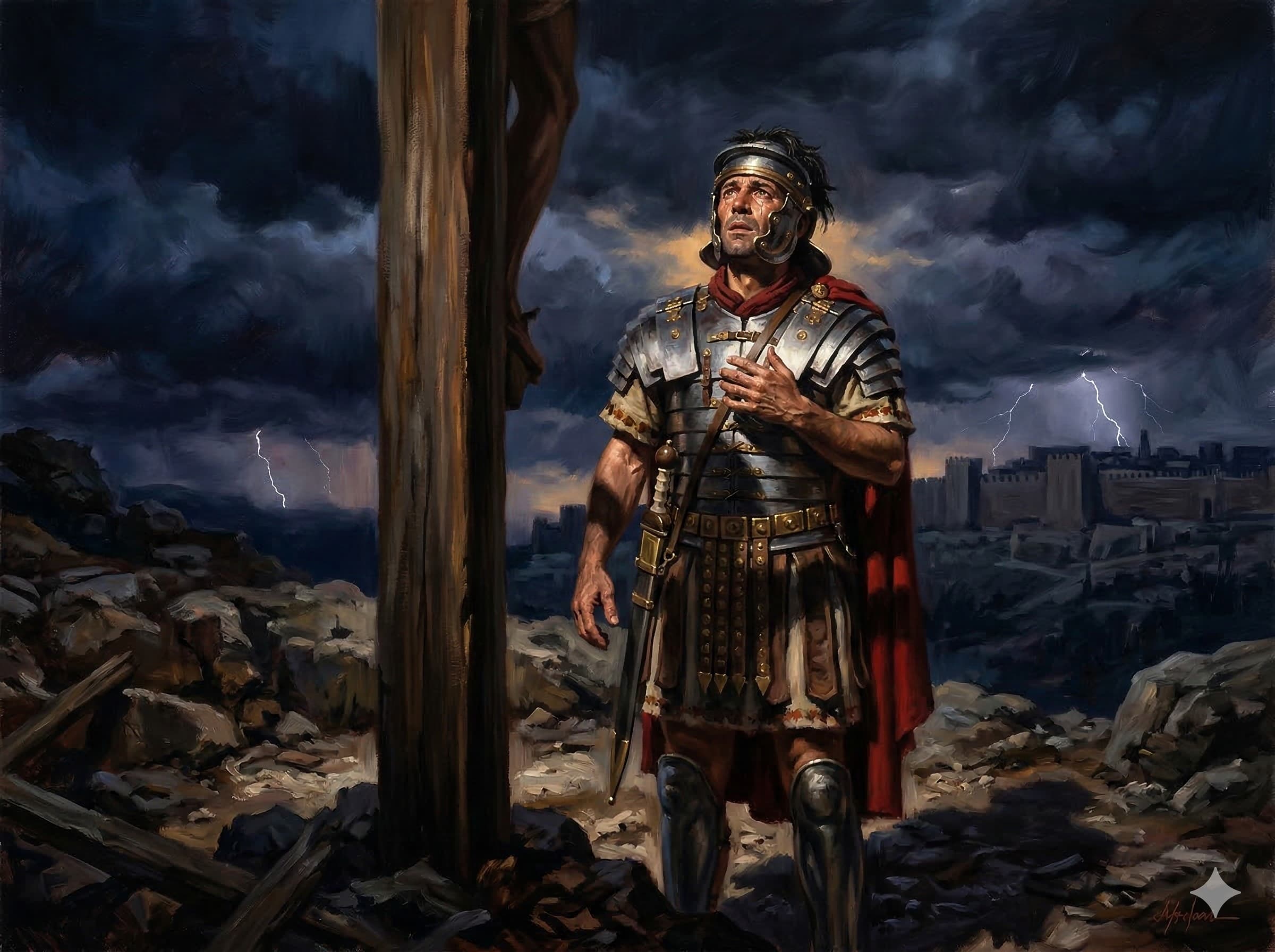
The Son of God. Mark announces this title in his opening verse. But the recognition follows a striking progression: early in the Gospel, only the demons recognize Jesus (3:11, 5:7). The disciples struggle. The crowds wonder. It is not until the cross — at the moment of Jesus' greatest apparent weakness — that a human being finally confesses it. A Roman centurion, watching Jesus breathe His last, declares: "Truly this man was the Son of God" (15:39). Divinity is recognized not in power but in sacrifice.
The Davidic King. Jesus is the heir to David's throne, yet Mark highlights what scholars call the "Messianic Secret." Jesus repeatedly silences those who recognize Him as the Messiah. Why? Because the title could not be safely proclaimed until the cross had redefined it. Without the cross, "Messiah" meant a political liberator. After the cross, it means something the world had never imagined.
The Suffering Servant. Grounded in Isaiah's prophecy and the theology of the ransom, Jesus identifies Himself as the Servant who does not conquer through the sword but through obedient suffering — the substitutionary payment for sins, buying us back from our lost condition.
This is the paradox at the heart of Mark: the Mighty Messiah is also the Suffering Servant. The crown is real — but the throne is a cross.
The Kingdom: Already, but Not Yet
Mark's Jesus announces from the beginning that the Kingdom of God is "at hand" (1:15). But the Kingdom Mark describes did not match anyone's expectations. It was not a political coup or a military revolution. It was a spiritual reality breaking into history — present in Jesus' authority over demons and disease, yet still awaiting a future consummation when the Son of Man will return in glory.
This "already-but-not-yet" framework mattered enormously to Mark's original readers in Rome. They were suffering now. Where was the Kingdom? Mark's answer: the Kingdom is here in the person of the King, and the King chose the way of the cross before the way of the crown. The same is asked of His followers.
The Abrupt Ending
The Gospel of Mark ends in the most unusual way in all of Scripture. The earliest and most reliable manuscripts conclude at 16:8. The women arrive at the empty tomb. A young man in white tells them Jesus has risen. And then: "They went out and fled from the tomb, for trembling and astonishment had seized them, and they said nothing to anyone, for they were afraid."
That is it. No resurrection appearances. No Great Commission. No satisfying wrap-up. Later scribes added verses 9–20, but these are marked by a different vocabulary and an awkward transition that most scholars recognize as a later addition.
Why end this way? Because Mark wants the weight of the story to land on you. The tomb is empty. The Messiah who was crucified is alive. Now — what will you do with that? The ending is deliberately open because Mark's Gospel is not a story to be finished. It is a question to be answered.
What Mark Asks of Us
The Gospel of Mark strips the Christian faith down to its most essential confrontation. There are no lengthy sermons to study, no detailed birth narratives to admire, no extended theological discourses to parse. There is only a Man of astonishing power who willingly lays that power down, walks to a cross, and pays a ransom for people who do not deserve it — including the disciples who abandoned Him and the centurion who executed Him.
Mark asks only one question, but it is the question on which everything turns: Who is this man?
If He is just a teacher, then His words are interesting. If He is just a healer, then His miracles are impressive. But if He is the Son of God who came "not to be served but to serve, and to give his life as a ransom for many" — then everything changes. Then the only fitting response is the one Mark's entire Gospel demands: deny yourself, take up your cross, and follow Him.
The shortest Gospel leaves you with the biggest question — and nowhere to hide from the answer.