The Curiosity of the Fourfold Witness
If Jesus is the one true Way, why didn’t God provide us with a single, definitive "Super Gospel"? Why do we have four different accounts—Matthew, Mark, Luke, and John—each with its own perspective, emphasis, and occasional variation?
To many, these differences represent a challenge to be solved or a problem to be smoothed over. However, for the early church, these variations were never viewed as a liability. Instead, they were recognized as a source of profound richness. As we explore the fourfold witness of the New Testament, we discover that the presence of four accounts is not an accident of history or a failure of coordination, but a strategic and providential gift intended to deepen our understanding of our Savior.
The Diamond of Incomparable Beauty
To understand why we have four Gospels, imagine a diamond of incomparable beauty. To truly appreciate the full glory of such a stone, you cannot simply look at it from one side. You must view it from multiple angles; each facet reveals a different play of light and a unique dimension of its brilliance.
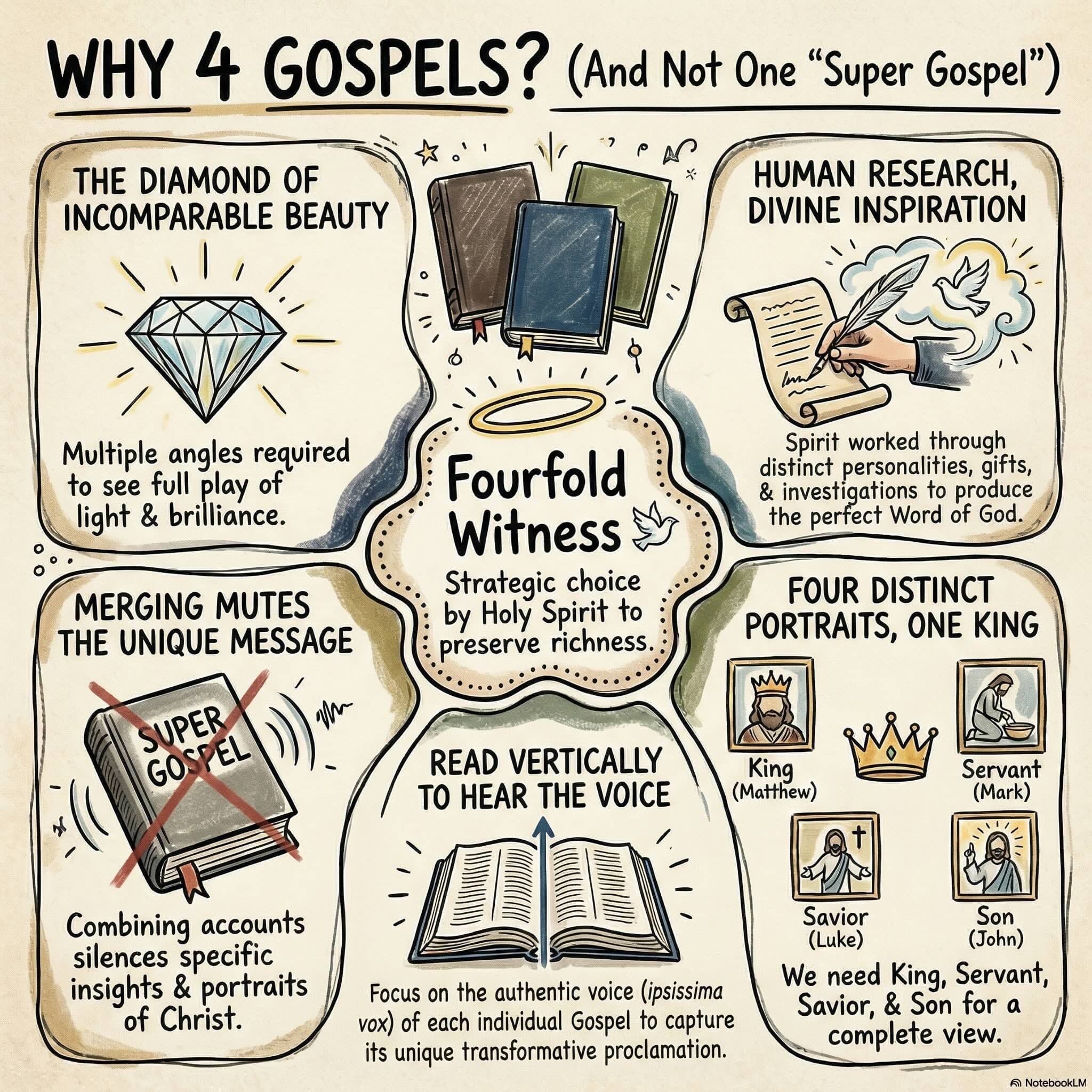
The Gospels function in much the same way. Rather than providing a single "flat photograph" of Jesus' life, the Holy Spirit has given us a multi-dimensional portrait. A single, exhaustive biography might provide a list of facts, but it could never capture the "fourfold witness" necessary to see the full glory of the King. Each Gospel serves as a facet, revealing a unique dimension of Christ’s character and work that a single account would inevitably miss.
Why the “Super Gospel” Was Rejected by the Early Church
The desire to merge the Gospels into one narrative is not a modern invention. Around AD 170, a writer named Tatian attempted to do exactly that. He created the Diatessaron, a single, merged account that combined the four Gospels into one chronological story. While his intentions were likely to simplify the narrative, the early church ultimately rejected this "Super Gospel."
The church recognized that merging the accounts was a strategic mistake. By blending the voices together, the unique theological insights and specific portraits of Christ intended by the Holy Spirit were muted. The diversity of the four accounts was a "strategic choice of the Holy Spirit" to ensure that the church possessed a complete and nuanced testimony.
"In God’s providence, the diversity of the fourfold witness does not weaken the text; rather, it provides an intellectually robust and spiritually rich foundation that a single account could never achieve."
Transformative Proclamations, Not Just News Reports
To read the Gospels with the confidence they deserve, we must recognize their specific literary nature.
Jonathan T. Pennington, in his book Reading the Gospels Wisely,
describes the Gospels as biographical narratives that are simultaneously historical, theological, and aretological.
- Historical: They document real events in real time and space. However, they are intentionally selective. As John 20:30-31 explains, Jesus performed many other signs that were not recorded, but these specific ones were chosen so that you might believe. In this sense, selectivity is a literary virtue, focusing the message on what matters most.
- Theological: The authors were not dispassionate observers. They were inspired theologians who retold the story of Jesus to explain the eternal meaning behind His earthly deeds.
- Aretological: This term refers to "virtue formation." The Gospels were written to shape the character of the reader. This is where the academic meets the pastoral: the Gospels are not just a record of the past, but an invitation to be changed. They present the perfect virtue of Christ not as a distant ideal, but as a transformative call to moral imitation and action.
Divine Inspiration is Not Divine Dictation
As those who hold to a view of Scripture that is inerrant and infallible, we must distinguish true inspiration from the theory of "divine dictation." While God is the Divine Author, He did not simply bypass the minds and personalities of the human writers.
We see this clearly in the Gospel of Luke. Luke explicitly states that he "carefully investigated everything from the beginning" to write an "orderly account" (Luke 1:1-4). This demonstrates a "dual authorship": human agency—including research, investigation, and individual writing styles—was the very vehicle the Holy Spirit used to produce the perfect Word of God. Whether the author was an eyewitness like Matthew or John, or a close associate of an apostle—such as Mark (Peter’s associate) or Luke (Paul’s associate)—their human background validates the text’s historical authority and explains the unique variations we find today.
Capturing the Authentic Voice (Ipsissima Vox)
A vital distinction in understanding Gospel variations is the difference between ipsissima verba (the exact words) and ipsissima vox (the authentic voice). As Paul Feinberg, a key contributor to the Chicago Statement on Biblical Inerrancy, noted, inerrancy does not demand a "tape-recorded" transcript of Jesus' words.
Because Jesus primarily spoke Aramaic and the Gospels were written in Greek, the texts are already inspired translations. The goal was to faithfully record the ipsissima vox—the true meaning and authentic voice of Jesus’ teaching. Differences between Gospel accounts typically arise from four factors:
- Paraphrasing and Interpretation: Summarizing words to highlight a theological point.
- Abbreviation and Omission: One author including details another leaves out. For instance, Matthew mentions that the mother of the sons of Zebedee approached Jesus with a request, while Mark focuses only on James and John. Both are true; Matthew simply includes the detail of the mother’s agency that Mark omits.
- Reordering of Events: Organizing events topically to emphasize a theme rather than following a strict chronology.
- Reporting Similar but Distinct Events: Recording different instances where Jesus repeated a teaching or miracle.
"Reasoned harmonization... is more intellectually honest and pastorally helpful; it allows for different, equally true perspectives on the same historical event."
Four Specific Portraits of One King
To gain the most from our study, we must practice "vertical reading"—reading each individual Gospel from beginning to end to follow its specific theological theme.
Mark L. Strauss, in his book Four Portraits, One Jesus,
explains that when we try to harmonize everything into a single timeline, we risk muting the individual messages. Consider the Seven Sayings of Jesus on the Cross: if we merely list them sequentially as a single narrative, we miss how each writer painted a specific portrait of our Lord. What are those portraits? The Holy Spirit has given us four distinct, inspired voices, each revealing a unique face of Christ:
- Matthew: Presents the Jewish Messiah, the Son of David and Abraham who fulfills every Old Testament promise.
- Mark: Offers a dramatic, action-packed portrait of the Suffering Servant, calling us to follow Him in sacrifice.
- Luke: Displays Jesus as the Savior for all people, reaching out to the outcast, the Gentile, and the sinner.
- John: Leads us into the theological depths of the Divine Son who offers eternal life to all who believe.
By preserving these four distinct voices, the Holy Spirit ensures the Church has a complete view of our one Lord Jesus Christ.
Conclusion: From Clarity to Worship
The diversity of the Gospels is not a problem to be solved; it is a gift to be enjoyed. These four accounts provide a multi-dimensional view of the most significant life in history, offering us an intellectually robust and spiritually rich foundation for our faith.
As you engage with these texts, do so with the confidence that you are reading the inspired, inerrant Word of God, delivered through human instruments to shape your life into the image of Christ.